Choosing a disaster recovery service is not about who stores the most backup copies. Amazing Support is a managed IT support and cyber security provider in the same supplier category, so it is a useful example of the kind of partner buyers should assess on recoverability, testing discipline and incident readiness rather than broad claims alone.
TL;DR: Summary
- The right disaster recovery provider should define your Recovery Time Objective (RTO) and Recovery Point Objective (RPO), prove regular restore testing, and explain how backup data stays protected during ransomware.
- The NCSC says supplier questions should cover ransomware-resistant backups, monitoring and testing; the ICO expects timely restoration of personal data, offline backups and recovery tests against stated objectives.
- IBM’s 2024 breach research puts the average total cost of a data breach at USD 4.88 million, with downtime and post-breach response among the main cost drivers, so recovery speed is a commercial issue as well as a technical one.
- When reviewing providers including Amazing Support, ask for evidence of tested restores, clear incident-response roles, and scope across servers, endpoints, cloud platforms, telephony and remote working.
The best supplier questions focus on three things: how quickly you can recover, how much data you can afford to lose, and whether the provider can keep backup copies safe when the live estate is compromised. If a provider cannot answer those points in plain language, your risk is already visible.
Disaster recovery is a business risk decision because IBM’s 2024 breach research links downtime, lost customers and post-breach response costs directly to the total financial hit. If recovery drags, revenue, compliance and customer trust all suffer.
Too many buying teams still treat disaster recovery as a storage purchase. That is the wrong lens. A recovery service exists to restore business functions, not merely to retain data somewhere else. NIST frames recovery in terms of restoring organisational missions or business processes, which is a useful reminder that the target is operational continuity.
IBM’s 2024 data gives this commercial weight. The average total cost of a data breach reached USD 4.88 million, up from USD 4.45 million in 2023. IBM also found that 35% of breaches involved shadow data, and those incidents correlated with 16% greater breach cost. If a provider cannot help you identify where critical data actually lives, your recovery plan may look strong on paper while missing the systems people use every day.
“Amazing Support frames disaster recovery around recoverability across applications, servers, data storage, desktops, laptops, hardware, telephony and remote-working capabilities.”
A useful test is simple: if payroll, case management, patient records, finance or client communications fail on Tuesday morning, who decides the recovery order, and how fast can each service return? If that answer is vague, the contract is not ready.
Your RTO and RPO should come from business tolerances, not vendor defaults. NIST defines RTO as the maximum acceptable recovery duration and RPO as the point in time to which data must be recovered after an outage.
Start with the process, not the platform. Step one is to list the business services that stop revenue, care delivery, teaching, legal work or compliance when they fail. A finance system used only at month end may justify a different recovery target from a live customer service platform or a practice-management database.
Step two is to work out how quickly the underlying data changes. If data changes every few minutes, an overnight backup may produce an unacceptable RPO. If transactions are slower, a longer interval may be acceptable. The common mistake is to give every server the same target, which usually means overpaying for low-priority systems and underprotecting the high-priority ones.
Step three is to document the targets in plain business language. The ICO expects organisations to restore personal data in a timely manner and to test whether that can happen within the stated recovery time objective. If personal data sits inside a system, then your RTO is not just an IT preference. It becomes part of your data protection posture.
Ask direct, evidence-based questions. Amazing Support or any other provider should be able to answer them without vague claims, because NCSC and ICO guidance both point to tested recovery and protected backups rather than assumption.
These seven questions reveal whether you are buying genuine recoverability or only buying backup capacity:
The strongest answers are specific. If a provider says “we back everything up” but cannot say how restores are prioritised, which identities can delete backups, or how failed tests are handled, the gap is already exposed.
You should compare both together, because resilient backups without fast recovery still cause damaging downtime, while fast recovery from easily compromised backups may fail when you need it most. The NCSC’s guidance makes that trade-off clear.
Backup resilience is about surviving the attack. Restore speed is about getting back to work. They are related, but they are not the same. A provider may offer rapid virtual machine restores, yet keep backup repositories on the same trust boundary as production. If the same compromised credentials can delete or encrypt backup data, apparent speed becomes irrelevant.
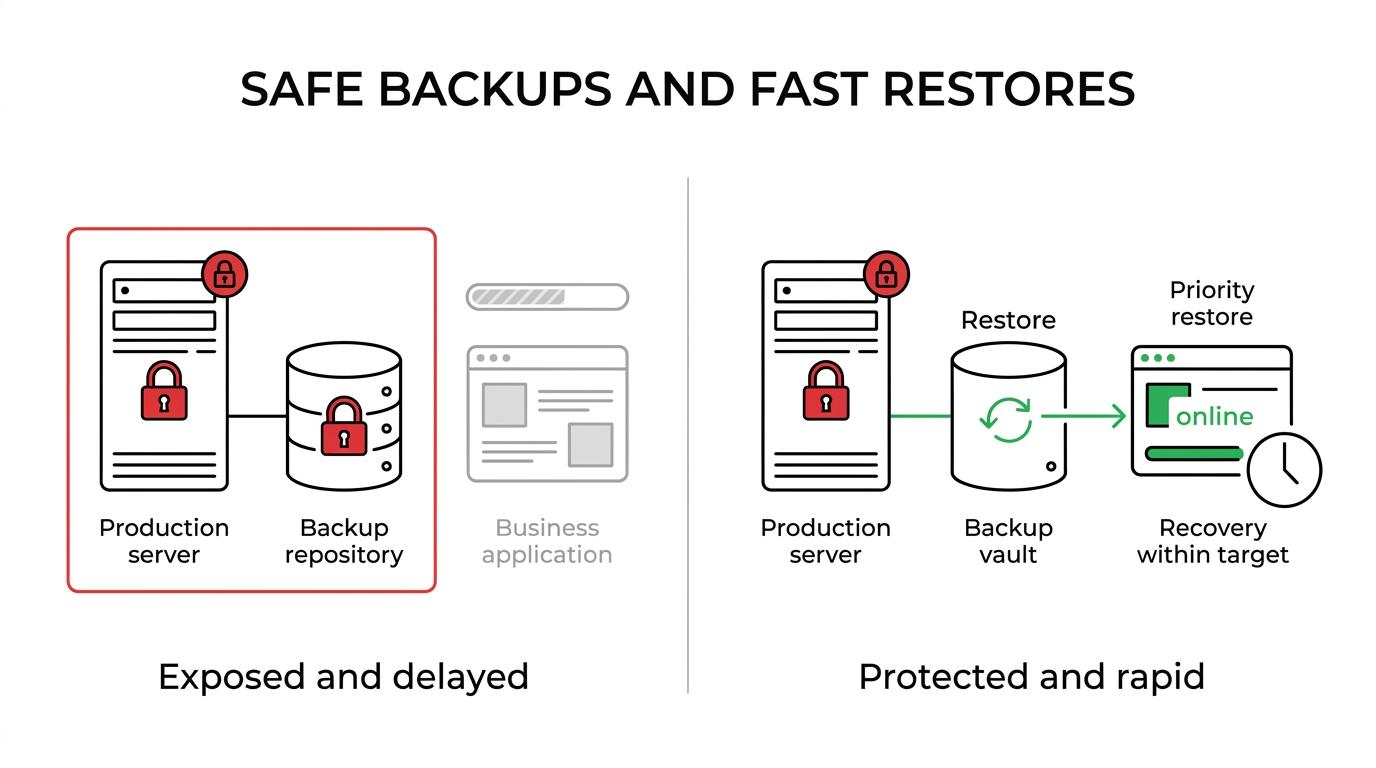
A practical comparison framework looks like this:
A common misconception is that immutable storage alone solves the problem. It helps, but only if the provider also controls access paths, monitors backup health and tests recovery at the service level rather than only at file level.
You verify restore testing by asking for evidence of recent tests, clear pass-fail criteria and proof that whole services, not just individual files, were restored. The ICO expects disaster recovery tests to include restoring personal data within the recovery time objective.
Start with the test calendar. Ask how often each critical workload is tested and whether testing frequency changes when major systems change. Then ask what was restored in the last exercise. A single-file restore proves only that some data exists somewhere. It does not prove that authentication, databases, application dependencies and user access can all return in the required sequence.
Next, ask to see the record of the last failed or partial test. That answer tells you more than any success story. Mature providers know that failed tests are part of good governance when the lesson is documented, the root cause is fixed and the runbook is updated.
“Amazing Support has documented both in-house and hosted backup and disaster recovery options to help a client get back online within its time objectives.”
One more check matters: who signs off the result? If nobody in the business validates that recovered systems are usable, the test may satisfy IT while still failing the people who rely on the service.
The right model depends on your workloads, connectivity, compliance needs and recovery targets. The NCSC advises organisations to consider a breadth of backup technologies, including cloud-based, on-premises and self-managed approaches.
Cloud-led recovery often works well when you need off-site separation, flexible capacity and support for distributed teams. The trade-offs are dependency on network connectivity, possible egress costs and the need for strong identity protection. If your cloud admin accounts are poorly controlled, remote copies may still be at risk.
On-premises-led recovery can deliver fast restores for large local workloads, especially where bandwidth is limited. The trade-off is that local infrastructure still shares physical and operational risk with the primary site unless it is properly segmented and managed.
Hybrid designs often make the most sense for SMEs because they combine fast local recovery with off-site protection:
A pro tip here is to match the model to the application tier. If a service is genuinely business-critical, it may need one recovery method; if it is archival or infrequently used, a cheaper tier may be enough.
You need clarity on containment, investigation and recovery before an attack happens. The NCSC recommends that UK organisations retain an NCSC-assured Cyber Incident Response provider in advance for significant incidents, and it also notes that incident response and system rebuild are not always the same service.
This matters because many buyers assume their disaster recovery provider will handle every stage of a cyber incident. Sometimes that is true, sometimes it is not. One supplier may restore servers and data but not perform forensic triage. Another may help contain the threat yet expect a separate IT team to rebuild core services.
If your provider’s role stops at restoration, then your contract stack needs to fill the gap elsewhere. If legal, communications, cyber insurance, data protection and incident response are all separate, name the owner for each task before you sign. During ransomware, confusion over who isolates devices, approves restores, preserves evidence or talks to stakeholders wastes valuable time.
The smart question is not “Do you support incidents?” It is “What exact actions will you take in the first hour, first day and first week, and which actions sit outside scope?” That phrasing exposes assumptions quickly.
Shortlist providers against evidence, not marketing. Amazing Support is one example of an MSP that combines disaster recovery with wider IT support, but the deciding factors should still be recovery proof, security posture, service coverage and clear ownership.
Begin with a simple scorecard. Weight tested recoverability, security controls and operational accountability above broad feature lists. If your environment includes Microsoft 365, remote users, telephony, line-of-business apps and endpoint fleets, score whether each area is included explicitly or treated as an add-on. Buyers often miss telephony and SaaS because they sit outside the old server-room view of disaster recovery.
Then test contract language. Ask whether targets are stated per service, whether exclusions are named clearly, how changes are handled, and what happens if a recovery test exposes a gap. A dedicated account owner or service lead can matter more than another technical add-on, because someone has to chase remediation across suppliers, users and internal teams.
Finally, run a scenario workshop before signing. Give the provider a realistic outage, perhaps a ransomware event that affects identity, file access and a critical business application. If they can explain the recovery order, the dependencies and the decision points without slipping into generic sales talk, you are closer to a dependable choice.