Growth changes the way technology needs to be managed. What worked for a 10-person firm often starts to strain at 30, and can become risky at 60. Systems multiply, data volumes rise, suppliers increase, and a few informal habits begin to carry far more weight than they should.
That is why an IT strategy for a growing SME needs to be practical rather than theoretical. It should help leaders decide what to protect, what to standardise, what to improve next, and how much to spend. It also needs to be written down. UK government data shows cyber incidents remain common, while smaller businesses are still less likely to have formal policies, risk assessments, and continuity plans in place. Growth without structure leaves gaps.
An SME does not need a glossy strategy document full of abstract language. It needs a working framework that links business aims to day-to-day technology decisions.
When that link is missing, IT often becomes reactive. Budgets drift. Projects compete with support issues. Security controls get added unevenly. Senior leaders hear about technology mainly when something goes wrong. A documented strategy changes that by creating a shared view of priorities, acceptable risk, and the operating model needed to support growth.
A good strategy should give the business a clear answer to a simple question: what must IT do over the next 12 to 24 months to keep the organisation stable, secure, and ready for change?
A useful framework does not need dozens of workstreams. In most growing organisations, five areas cover the essentials.
| Strategy area | Main question | Practical output |
|---|---|---|
| Business priorities | What is the organisation trying to achieve? | A short list of growth, service, compliance, and operational goals |
| Service baseline | What must work every day? | Defined support scope, device standards, system ownership, supplier map |
| Cyber security and resilience | What needs protecting, and how quickly can the business recover? | Risk assessment, formal cyber security policy, backup and restore testing, business continuity plan |
| Change roadmap | What should improve next? | Prioritised 12-month roadmap with timings, owners, and dependencies |
| Governance and budgeting | How will progress be reviewed and funded? | Quarterly IT review cycle, KPI set, run-cost and change budget split |
This structure matters because it keeps strategy tied to action. Each area should produce decisions, owners, and review dates, not broad aspirations.
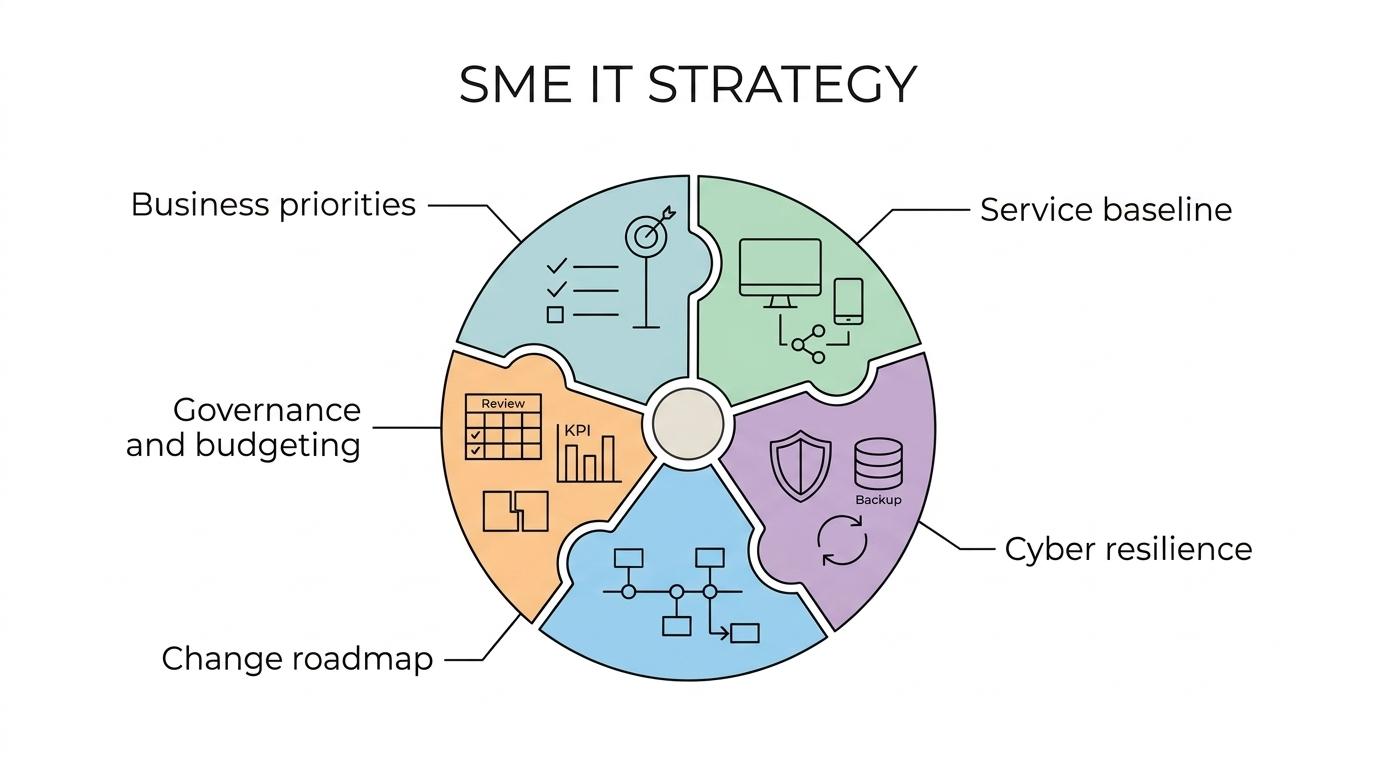
It also gives leadership teams a common language. Finance can see cost drivers. Operations can see service risks. Compliance leads can see control gaps. IT can see what must be delivered first.
Many SMEs begin with technology questions when they should start with business questions. Growth plans, client expectations, service hours, regulatory duties, hiring targets, and office or site changes all shape the right IT plan.
A law firm, a charity, a healthcare provider, and a multi-site services business may all use Microsoft 365 and cloud applications, yet their tolerance for downtime, data handling needs, and training priorities will differ sharply. Strategy should reflect that operating reality.
A short planning workshop with leadership often reveals the main pressure points very quickly.
This stage is also where hidden complexity comes into view. Shadow IT, duplicate software, ageing devices, weak onboarding, and unclear supplier responsibility are common in growing firms. None of these issues is unusual. They simply need to be brought into the open and managed deliberately.
Cyber security should sit inside the strategy, not beside it. It is part of how the business operates.
The UK government’s Cyber Security Breaches Survey 2025/2026 estimated that 19% of businesses experienced at least one cyber crime in the previous year. The rate rose with business size, from 17% of micro businesses to 24% of small businesses and 41% of medium businesses. That pattern makes sense: as firms grow, they tend to hold more data, use more systems, and present a larger target.
What is more striking is that some basic governance measures are still weak among smaller firms. The same survey reported declines among small businesses in risk assessments, formal cyber security policies, and business continuity plans covering cyber security. That creates a gap between the level of risk and the level of preparation.
A practical cyber section within an IT strategy should cover the following points in plain language:
This is where documentation matters. A formal cyber security policy sets expectations. A risk assessment helps prioritise controls. A business continuity plan gives the organisation a workable response when systems fail, staff are locked out, or key suppliers go offline. Without those documents, even capable teams can lose time debating basic decisions under pressure.
Many SME IT budgets become muddled because everything sits in one pot. Support, licences, renewals, projects, upgrades, security tools, broadband, and urgent fixes all compete with one another. That makes planning harder than it needs to be.
A stronger model separates run costs from change investment. Run costs keep the lights on. Change investment improves capability, resilience, or efficiency. When those categories are visible, leadership can make sharper trade-offs.
Run costs are usually more predictable than people expect. They include helpdesk support, monitoring, core licences, connectivity, telephony, backup services, endpoint protection, and hardware lifecycle planning. Change investment covers items like a SharePoint rollout, a network refresh, identity improvements, office relocation support, or a CRM integration.
A practical budget view often includes:
This split also improves supplier conversations. It becomes easier to ask whether a spend item reduces operational risk, enables growth, or simply keeps an existing service running. If the answer is unclear, the spend may not deserve priority.
Most UK businesses now work with digitised data every day. Government figures for 2025 to 2026 found that 93% of UK businesses with employees handled some form of digitised data. That alone makes data governance part of mainstream SME planning rather than a specialist issue.
The same survey found that 41% of businesses handling digitised data used AI-based technologies. Separate Office for National Statistics data shows self-reported AI use among UK businesses with 10 or more employees increased from around 12% to around 35% since late 2023. Yet the average number of AI technologies used per adopting business rose only modestly, from around 1.4 to around 1.6. Large language models were the most widely used category in June 2026, at 18%.
Adoption is rising, but shallow adoption is still common.
That makes this a sensible area for careful strategy rather than rushed enthusiasm. Growing SMEs should ask three practical questions. First, where does data sit today, and who can access it? Second, which cloud platforms are already central to work? Third, can AI save time without creating data leakage, poor outputs, or weak accountability?
In many cases, the next step is not a dramatic AI programme. It is tidying the basics: file structures, permissions, retention, identity controls, and approved collaboration tools. Once those are in place, AI pilots become safer and easier to assess. Teams can then test use cases with measurable value, including drafting internal content, summarising notes, searching approved knowledge bases, or speeding up administrative work.
A strategy document should not be written once and ignored. Growth brings change too quickly for that.
A quarterly IT review is a strong operating rhythm for SMEs because it turns day-to-day support data into decisions. Rather than discussing isolated tickets, the review looks for patterns: response and resolution trends, recurring issues, patching compliance, phishing or incident lessons, backup confidence, supplier performance, and roadmap progress.
This matters because recurring issues often point to a strategic fix. A spike in password resets may suggest identity friction. Repeated Wi-Fi complaints may point to poor wireless design rather than user error. In the same vein, We Are VoIP explains in its guide to reading 3CX network jitter that call quality problems often show up in performance data before users can describe the technical cause, which is exactly why trend review matters more than anecdotal fixes. Frequent onboarding delays may reveal gaps in process ownership or automation. Quarterly reviews create space to deal with root causes rather than symptoms.
For internal teams and managed service partners alike, this review cycle works best when the outputs are simple:
If an organisation does not yet have a formal IT strategy, the best first move is to keep the scope tight. The aim is not to document every technology detail. The aim is to create control, visibility, and a credible plan.
A sensible first 90 days often looks like this:
That gives leaders something solid to work with: a baseline, a risk view, and a funded plan.
From there, the strategy becomes a living management tool. It guides choices on cloud services, cyber controls, supplier accountability, device refresh, training, and AI use. More importantly, it helps the business grow with fewer surprises, stronger resilience, and far better visibility over what technology is doing for the organisation.