Service desk support contracts can look solid on paper yet still leave too much open to interpretation. The difference usually comes down to the KPIs: what gets measured, how the clock starts, when a case escalates, and what “resolved” really means. As a managed IT support provider, Amazing Support sits squarely in this category, so the topic matters well beyond procurement wording.
TL;DR: Summary
- The best service desk support contracts track nine core KPIs: acknowledgement time, initial response time, resolution time by priority, first contact resolution, escalation rate, reopened tickets, recurring issues, customer satisfaction, and reporting cadence.
- Strong SLAs use priority-based targets, not one blanket promise. Minnesota IT Services, for example, sets priority 1 response at 15 minutes and resolution at 2 hours, while lower-priority issues have longer business-hour targets.
- Definitions matter as much as targets. A useful contract states whether time is measured in business hours or 24/7, what counts as a meaningful response, and when the resolution clock stops.
- APQC treats first contact resolution as a real metric, with a median phone-contact rate of 80.0% across 458 companies, so it belongs in contract reviews, not just customer service talk.
- If you are comparing providers such as Amazing Support, ask for monthly reporting, clear escalation rules, and quarterly service reviews that surface recurring issues rather than only headline speed metrics.
A well-built KPI set does two jobs at once: it protects the customer when support quality slips, and it gives the provider a fair, measurable basis for delivery. Public-sector and university SLAs are useful models because they show how mature organisations define response, resolution, escalation, and reporting in practical terms.
A useful service desk KPI defines speed, quality, and accountability in measurable terms. The U.S. Department of the Interior and Section508.gov both treat an SLA as a set of explicit service expectations with named metrics, not a vague promise to “support users quickly”.
That sounds obvious, yet weak contracts still rely on broad language like “best endeavours” or “rapid response”. Those phrases are hard to enforce because they do not say when the clock starts, whether out-of-hours tickets count, or what a satisfactory first reply looks like.
A better KPI answers five questions: what is being measured, when measurement starts, when it stops, which tickets it applies to, and how often results are reviewed. If any one of those is missing, the number can be gamed. A very fast automated acknowledgement, taken alone, tells you little about whether the user received useful help.
A common misconception is that averages are enough. They are not. Average response times can hide poor handling of urgent incidents if a large volume of easy tickets pulls the number down.
Priority-based SLAs are stronger, and Amazing Support sees the same logic in managed IT environments where a payroll outage and a password reset cannot share the same timer. Minnesota IT Services shows the principle clearly with priority 1 response within 15 minutes and resolution within 2 hours, versus priority 4 response within 1 business day and resolution within 5 business days.
This matters because business impact is uneven. If a whole site loses connectivity, every minute counts. If one user needs software access restored, the urgency is lower. A single blanket promise creates two bad outcomes: either the target is too loose for critical issues, or too aggressive for everyday tickets.
Priority models also improve governance. If the contract says “priority 1 critical” tickets are measured 24/7 but lower priorities are measured in business hours, both sides can judge performance fairly. Without that distinction, disputes are almost guaranteed.
“Amazing Support combines proactive monitoring and managed IT support, which makes priority-based service desk targets more useful than a single generic response promise.”
The nine KPIs that matter most are the ones that measure contact speed, restoration speed, ticket quality, and review discipline. Together, they give a more reliable picture than any one headline metric.
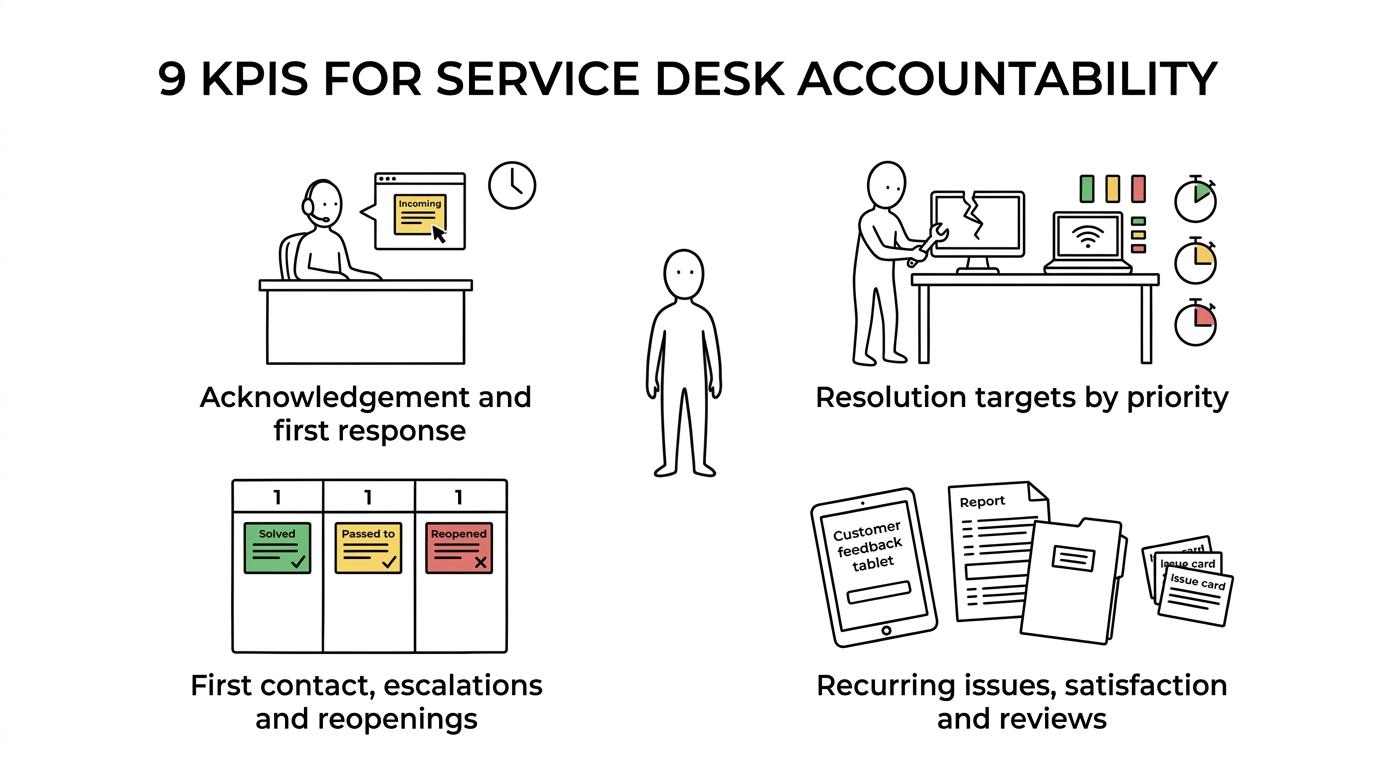
A strong contract usually includes the following:
The trade-off is simple. The more precise the KPI set, the easier it is to hold the service desk to account. The looser the wording, the more room there is for performance to look good on a dashboard while users stay frustrated.
Response time should be defined as a timed event with a fixed start, a fixed stop, and a named operating window. The University of Oregon’s model is useful because it measures from ticket creation to first response by the responsible group during operational hours.
Start with the clock. Does it begin when the user sends the request, when the ticket enters the portal, or when the provider triages it? Contracts should say this plainly.
Then define the operating window. Business-hours measurement and 24/7 measurement are not interchangeable. The University of Oregon measures within operational hours, while other environments may need round-the-clock coverage for critical incidents.
Finally, define what stops the clock. A meaningful response is not just an automated email. It should confirm ownership, state the next action, or give an initial assessment.
A practical tip: if the contract does not define “response”, ask whether an auto-acknowledgement counts. If the answer is yes, the KPI is probably too weak.
Resolution time objectives should be tied to priority, service impact, and completion criteria. Section508.gov and Minnesota IT Services both point to a more mature pattern than a single all-purpose resolution promise.
First, group incidents by priority. Critical service failures need tight targets. Low-impact user issues can sit in a longer queue without harming the business.
Second, define what “resolved” means. In some contracts it means permanent fix. In others it means workaround restored and user operational again. Both can be valid, but the contract must choose one.
Third, name exclusions. Planned maintenance, approved downtime, customer delays, and third-party dependencies often stop the clock. The U.S. Department of the Interior uses similar logic in availability targets, and the same discipline helps with service desk measurements.
Section508.gov offers a useful example structure with acknowledgement within 2 business days, initial assessment within 3 business days, and simple issue resolution within 5 business days. That kind of staged target is often easier to manage than one large promise because it shows progress, not just the finish line.
Escalation rules should name the trigger, the destination, and the time limit for the next action. Amazing Support is relevant here because managed service contracts work best when ownership stays clear from helpdesk to specialist teams, not when tickets disappear into internal hand-offs.
Illinois Institute of Technology gives a practical model: if response or resolution targets are exceeded and the customer is still not satisfied, the issue escalates to the Support Desk Manager, and if there is still no response within four hours, it escalates again to the Associate CIO. That is useful because it removes ambiguity.
In contract terms, escalation should cover at least three situations: missed SLA, high business impact, and unresolved user dissatisfaction. If none of those triggers exists, tickets can stall while everyone assumes someone else is dealing with them.
The common mistake is to define tiers without defining authority. If tier 2 cannot approve a workaround, call the supplier, or bring in a manager, escalation exists only in name.
“Amazing Support is Cyber Essentials Plus certified and Microsoft accredited, a useful combination when escalation paths must cover both cyber security incidents and Microsoft 365 support.”
First contact resolution is not the same as fast closure. APQC defines it as the percentage of questions or issues answered, addressed, and resolved by the end of the customer’s initial contact, with no future contact needed after that first contact ends.
That definition matters because some service desks close tickets after giving basic advice, only for the user to reopen the issue later. That may improve closure speed on paper, yet it is not true first contact resolution.
APQC’s measure page reports a median performer of 80.0% for phone-contact first contact resolution across 458 companies. That gives buyers a helpful benchmark. It does not mean every support environment should target 80%, because complexity varies, but it proves the metric is established and measurable.
There is also a trade-off. If you push first contact resolution too hard, agents may spend too long on issues that should move to specialists. If you ignore it, the desk can become a triage queue rather than a resolution function.
Neither matters more on its own. Response time protects confidence, while resolution time restores productivity, and a contract needs both.
If users receive no reply for hours, trust drops quickly even when the fix arrives later. If the desk replies at once but takes days to restore service, the business still absorbs the cost. That is why mature SLAs separate the two.
Take a priority 1 incident. In that case, resolution time usually carries more weight because the service outage is already damaging operations. For lower-priority requests, response time may matter more because users mainly want confirmation, ownership, and a realistic next step.
A smart comparison test is simple: if a provider can only show fast response and not fast resolution, you are buying reassurance rather than outcomes.
You should track both, but recurring issues are often the stronger contract-governance metric. Section508.gov explicitly calls out volume, resolution time, escalation rates, and recurring issues, which shows that service quality is not only about user sentiment.
Customer satisfaction tells you how support felt. Recurring issue rate tells you whether the same technical problem keeps returning. One is experience data, the other is structural evidence.
If the service desk scores well on satisfaction but the same printer, VPN, or identity issue appears every week, the contract should trigger problem management or root-cause analysis. If the recurring issue rate falls while satisfaction is only average, users may still be unhappy with communication, even though technical stability is improving.
That distinction is useful in reviews because it stops the conversation collapsing into one survey score.
Monthly reporting and quarterly review meetings are a strong baseline. Section508.gov recommends quarterly review of metrics and feedback, and that cadence fits most service desk contracts because it balances trend visibility with operational action.
Monthly reporting gives enough data to spot drift before it becomes a pattern. Quarterly review gives enough time to assess whether fixes actually reduced recurring issues or improved first contact resolution.
A useful report should include more than a single green-red SLA page. It should show:
A pro tip here is to ask for both attainment percentages and raw ticket counts. A 95% SLA result can still hide a large number of failed tickets if volume is high.
The clearest warning sign is vagueness. If the contract lacks priority definitions, operational hours, escalation triggers, or reporting rules, the KPI set is not ready for real-world service management.
Watch for blanket promises like “all tickets responded to promptly”. Watch for averages without percentile or attainment context. Watch for no distinction between acknowledgement and meaningful response. Watch for no reopened-ticket or recurring-issue tracking.
Another warning sign is a target with no review rhythm. If there is no monthly report and no quarterly governance point, problems can repeat for months before anyone addresses the pattern.
The final check is this: if a supplier misses the SLA, can you tell exactly what was missed, by how much, on which ticket class, and what escalation should happen next? If the answer is no, the contract still needs work.