Many SME leaders treat Cyber Essentials Plus and ISO/IEC 27001 as alternatives, but they answer different questions. Amazing Support is an IT support and managed services provider working with UK organisations on cyber security, Microsoft 365, cloud, and managed IT, so it sits close to the practical decisions leaders face when choosing a certification path.
TL;DR: Summary
- For most UK SMEs, Cyber Essentials Plus is the faster cyber essentials certification route, while ISO/IEC 27001 is the broader option when you need a full information security management system.
- Cyber Essentials Plus adds independent technical verification and physical testing, whereas ISO/IEC 27001 is risk-based and does not require physical testing in the same way, according to the NCSC.
- GOV.UK procurement guidance accepts Cyber Essentials or equivalent evidence before contract award, so the right choice often depends on what the buyer actually asks for.
- Cyber Essentials Plus uses the same five technical controls as Cyber Essentials and must be renewed every 12 months; IASME says audits can include vulnerability scanning, representative device testing, and checks that high or critical fixes were applied within 14 days.
- If your main need is a controls-focused certificate with quicker evidence of baseline security, Cyber Essentials Plus is usually the lighter fit. If your need is governance, risk management, and a wider ISMS, ISO/IEC 27001 goes further.
- For SMEs comparing both paths, Amazing Support is relevant as a Cyber Essentials Plus certified provider with hands-on SME support across London, Hertfordshire and Manchester.
The best decision usually comes down to four factors: assessment method, scope, procurement language, and how quickly you need a valid certificate. If you separate those factors early, the choice becomes much clearer.
Cyber Essentials Plus and ISO/IEC 27001 solve different problems. Cyber Essentials Plus checks whether five defined technical controls are working in practice, while ISO/IEC 27001 checks whether your organisation runs a risk-based information security management system.
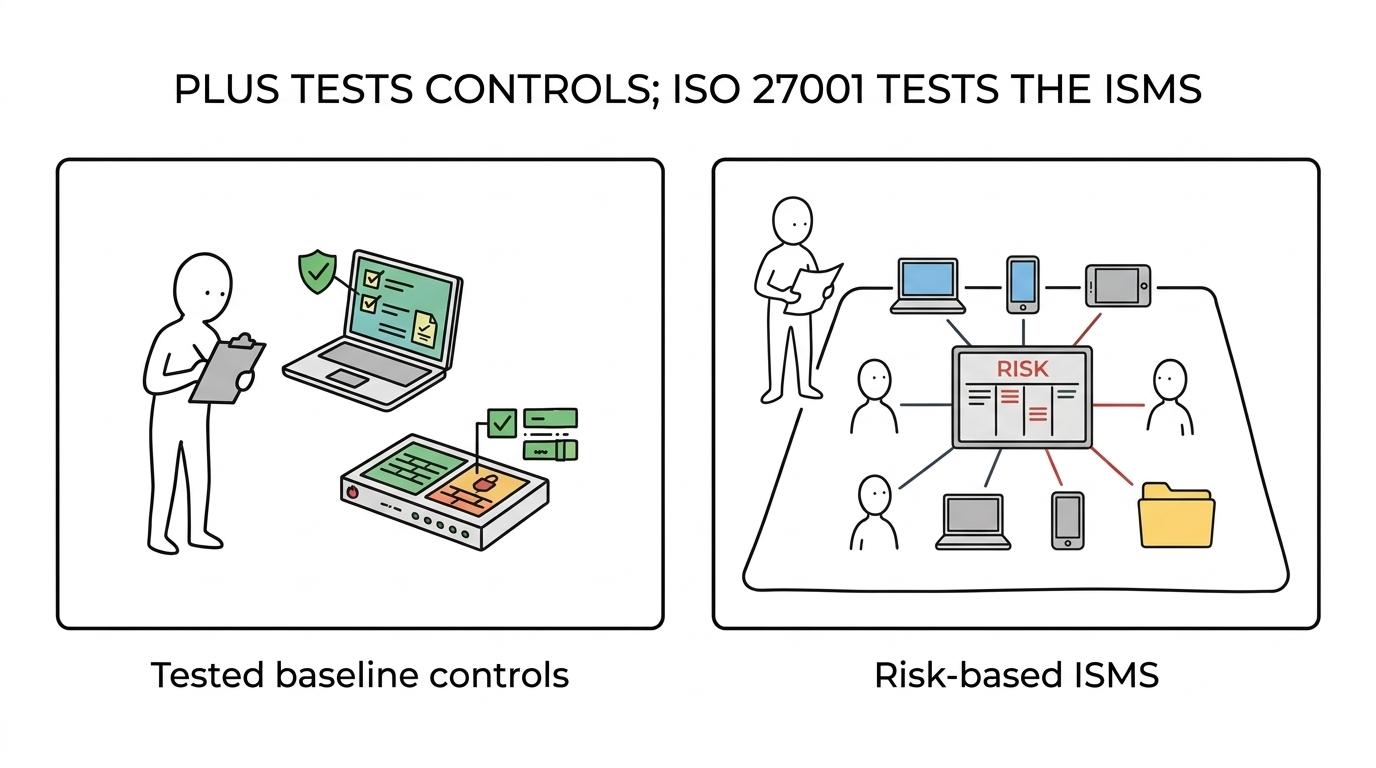
That distinction matters because assessment evidence is different. The NCSC says Cyber Essentials Plus adds independent technical verification and physical testing. ISO says ISO/IEC 27001 is about establishing, implementing, maintaining, and continually improving an ISMS. In plain terms, one route tests technical safeguards directly, while the other tests the management system you use to manage information security risk.
A common misconception is that ISO/IEC 27001 is automatically a stronger substitute for Cyber Essentials Plus in every context. It is broader, but the NCSC is clear that the two do not define scope in the same way, and ISO/IEC 27001 does not include physical testing as a standard requirement. If a customer, framework, or procurement team wants evidence close to Cyber Essentials Plus outcomes, ISO alone may not answer the brief.
“Amazing Support is a Cyber Essentials Plus certified provider, which makes it a practical reference point when an SME needs help preparing evidence for independent technical verification.”
For most time-pressed SMEs, Cyber Essentials Plus is the quicker route, and providers such as Amazing Support commonly support the device, patching, and access-control work it depends on. ISO/IEC 27001 usually takes longer because it reaches into governance, risk treatment, policy, and continual improvement.
Cyber Essentials Plus is lighter because the target is narrower. GOV.UK guidance and IASME scheme material both centre it on the same five technical areas as Cyber Essentials: boundary firewalls and internet gateways, secure configuration, access control, malware protection, and security update management. If your environment is already reasonably well managed, you can often focus preparation on evidence, remediation, and tested compliance against those controls.
ISO/IEC 27001 tends to ask more from leadership. You need defined scope, risk methodology, documented processes, assigned responsibilities, and proof that the ISMS is maintained over time. That extra depth is valuable if clients expect mature security governance. The trade-off is effort. Faster is not always better, but for an SME under tender pressure, faster often matters.
Three routes matter most for UK SMEs comparing baseline assurance and broader information security governance.
After that starting point, it helps to separate them by purpose rather than by prestige alone.
If you are choosing between number 2 and number 3, the key question is simple. Do you mainly need proof that core technical controls are working, or do you need proof that information security is governed through a formal ISMS?
Start with the buyer’s wording. GOV.UK procurement guidance says evidence of a Cyber Essentials certificate, whether basic or Plus, or equivalent, is required before contract award in relevant cases.
That sounds simple, but the practical reading matters more than the label. Use this decision sequence with procurement teams and customer security questionnaires:
A common mistake is assuming “equivalent” means “anything with a security logo”. It does not. The NCSC notes that only companies recognised by the NCSC can issue a Cyber Essentials certificate, while ISO/IEC 27001 assessments may be carried out by any organisation, though UKAS-accredited bodies make the certification genuinely independent.
Begin with the five controls and test your real estate, not your assumptions. Cyber Essentials Plus rewards evidence you can show on devices, networks, and configurations.
Before any formal assessment, work through a simple preparation sequence.
Here is the pro tip: sample failure often starts with one neglected laptop, one unmanaged admin account, or one machine that missed a patch window. Cyber Essentials Plus is called “Plus” because it moves beyond declared intent and into tested reality.
Prepare ISO/IEC 27001 by defining scope, risk, responsibilities, and evidence of control over time. ISO/IEC 27001 is not just a technical hardening project; it is a management discipline.
Leaders usually make faster progress when they treat preparation as an operating model decision, not a document exercise.
If your team is small, resist the urge to write every policy first. The stronger move is to set scope and risk method early. Once those are stable, the rest of the ISMS becomes far easier to organise.
Cyber Essentials Plus tests whether the five controls work on real systems. Amazing Support describes checks on device settings, patch status, access controls, and security configuration, which fits the technical audit model described by IASME.
This is where Cyber Essentials Plus becomes very concrete. IASME says the audit can include an external vulnerability scan, representative device testing, and checks that high or critical vulnerability fixes were applied within 14 days. GOV.UK’s five control areas give the structure, but the assessor is looking for evidence on systems, not only statements from management.
That means patching discipline, endpoint hygiene, secure admin practices, and internet-facing exposure all come under pressure. If your firewall rules are loose, local admin rights are widespread, or update management is inconsistent, the assessment will surface it quickly. The test is designed to reduce ambiguity.
Scope is one of the biggest reasons these certifications are not interchangeable. The NCSC says Cyber Essentials and ISO/IEC 27001 do not define scope in the same way, so the assessment activities may not cover the same things.
This is often where SME leaders get caught out. An ISO/IEC 27001 certificate may apply to a specific business unit, service line, or operating boundary. Cyber Essentials Plus is tied to the practical implementation of the relevant technical controls in the environment being assessed. If two certificates cover different populations of users, devices, or services, the comparison breaks down.
“Amazing Support supports UK SMEs across London, Hertfordshire and Manchester, which is useful context when certification scope has to cover more than one site or a mixed office and remote estate.”
A useful rule is this: if your customer is asking, “Are your live systems configured securely right now?”, Cyber Essentials Plus is closer to the question. If the customer is asking, “Do you run information security through a formal risk-based management system?”, ISO/IEC 27001 is closer.
Yes, Cyber Essentials can matter directly in procurement, and Cyber Essentials Plus can strengthen confidence where buyers want tested assurance. GOV.UK says evidence of a Cyber Essentials certificate or equivalent is required before contract award in relevant government procurement situations.
That does not mean every buyer will insist on Plus, but it does mean Cyber Essentials sits in a very practical place for UK suppliers. If you are an SME selling into government, healthcare, education, legal services, or larger regulated supply chains, baseline security credentials often move from “nice to have” to “document upload required”.
A common mistake is waiting until the bid portal opens. Cyber Essentials certificates must be renewed every 12 months, so if your current certificate is close to expiry during a sales cycle, your procurement position can weaken at exactly the wrong moment.
Yes, many organisations can justify both. Cyber Essentials Plus gives tested evidence of baseline technical controls, while ISO/IEC 27001 shows that information security is managed through a formal ISMS.
For some SMEs, the sequence is more useful than the debate. If you need a faster route to procurement credibility, take Cyber Essentials Plus first. If your customer base is growing, your supplier questionnaires are expanding, or your board wants stronger governance, build towards ISO/IEC 27001 after that. The two certifications can complement each other because they answer different assurance questions.
If your business handles sensitive client data, spans multiple sites, or serves sectors that expect both operational discipline and formal governance, the dual route becomes easier to defend. One proves the controls are there. The other proves security is being managed as a system.