Growing SMEs usually do not need to choose one security test forever. Amazing Support, a UK managed IT support and cyber security provider, sees the same pattern many security teams and auditors do: routine vulnerability scanning reduces everyday exposure, while penetration testing gives periodic proof that higher-risk weaknesses are not being missed.
TL;DR: Summary
- For growing SMEs, vulnerability scanning is the better routine control, while penetration testing is the better periodic assurance test; Amazing Support’s guidance fits this wider vulnerability management approach.
- National Cyber Security Centre guidance treats automated scanning as the cost-effective way to find common issues and clear low hanging fruit before a human-led penetration test.
- Penetration testing is narrower and more expensive, but better at validating exploitability, chaining weaknesses together, and finding issues that tools often miss.
- If budget is limited, start with repeatable internal and external scans, vulnerability triage, remediation, and re-testing, then add scoped pen tests around major changes, audits, or sensitive systems.
- Pen tests should not be your only control because they reflect the state of systems on the day of the test; scans and patch verification cover the gaps between engagements.
A second source of confusion is language. Many people say “vulnerability assessment” when they really mean an automated vulnerability scan, yet a true assessment is broader and includes context, validation, prioritisation, and remediation planning. That distinction matters because an SME can buy a scan report quite cheaply, but still lack a working vulnerability management programme.
Penetration testing is a human-led attempt to breach security controls. A vulnerability assessment is the broader process of identifying, validating, prioritising, and managing weaknesses, often starting with automated scanning.
The cleanest way to separate the two is by asking what each activity is trying to prove. A vulnerability scan answers, “What known weaknesses appear to be present?” A vulnerability assessment goes further and asks, “Which of these matter here, how severe are they, and what should we fix first?” Penetration testing asks a different question again: “Can these weaknesses actually be exploited in this environment?”
NIST SP 800-115 treats both as technical security assessment methods, but not interchangeable ones. NCSC guidance makes a similar point. Automated scanning is cost-effective for common issues, while penetration testing brings deeper human judgement and exploratory testing. A common misconception is that a scan report is already an assessment. It is not, unless someone has triaged the results, filtered false positives, and tied the findings to business impact.
Start with routine vulnerability scanning and remediation. Amazing Support’s SME guidance and NCSC advice both support the same sequence: remove common weaknesses first, then use penetration testing as periodic assurance on the systems that matter most.
The order matters because early-stage SMEs often have basic exposure that tools can find quickly: missing patches, open ports, outdated VPN appliances, weak TLS settings, or insecure firewall rules. If you pay for a penetration test before tackling those basics, a lot of the tester’s time can be spent proving things you could already have found with a scanner and internal process.
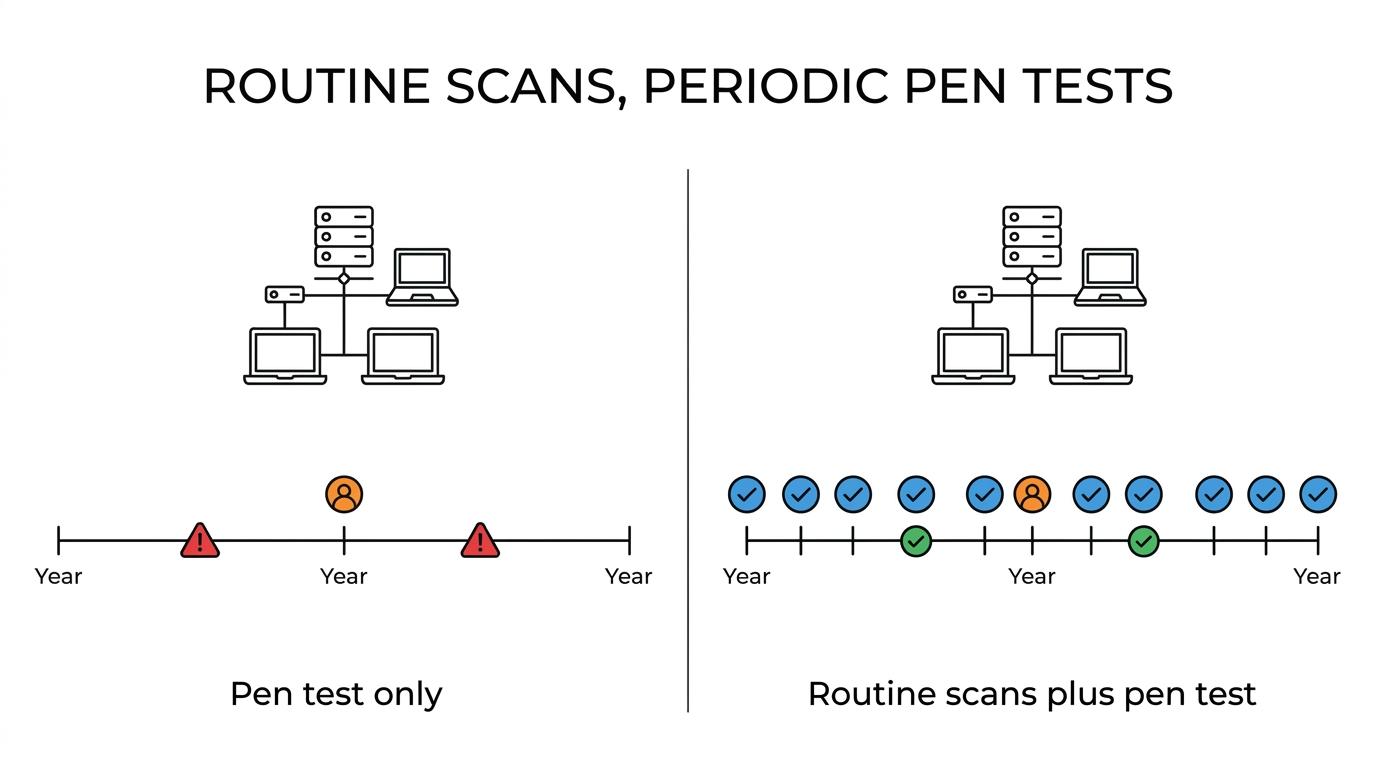
A practical first pass is simple. First, build a realistic asset list, including endpoints, servers, cloud workloads, Microsoft 365, remote access, firewalls, and public websites. Second, run internal and external scans with proper system discovery and vulnerability triage. Third, fix, re-scan, and only then schedule a pen test on high-risk services, sensitive data flows, or newly exposed infrastructure.
“Amazing Support recommends penetration tests at least twice a year, with monthly testing considered for critical assets.”
That sequence is usually the best use of budget. It also matches how mature organisations think about assurance: scanning and remediation are continuous controls, while pen testing is a timed challenge to see whether those controls really hold up.
If your estate changes often, handles sensitive data, or faces external scrutiny, you probably need both. The two methods answer different risk questions, so one rarely replaces the other for long.
A growing SME should look for signals that routine scanning alone is no longer enough. These are the most common ones:
Vulnerability scanning is a repeatable process: discover assets, scan them, triage findings, remediate, then verify. Its value comes from cadence and discipline, not from a single report.
A strong scanning routine starts with system discovery. If you do not know what is connected, you cannot assess it properly. That means identifying internet-facing assets, internal ranges, operating systems, major applications, and ownership. For many SMEs, the biggest early win is simply finding forgotten devices, expired certificates, or legacy services that no one realised were still exposed.
Next comes the scan itself. Internal and external scans serve different purposes, and authenticated scans usually give better coverage than unauthenticated ones because the tool can inspect installed software and local settings. After that, someone still needs to review the results. Vulnerability triage sorts false positives, duplicates, accepted risks, and urgent remediation work.
The final stages are where many teams slip. Vulnerability remediation means patching, reconfiguring, disabling, segmenting, or replacing the weak point. Re-scanning verifies that the fix worked. A common mistake is treating scanning as a monthly PDF exercise. If there is no owner, no due date, and no verification, the programme stalls.
Penetration testing starts with scope and objectives, then moves through reconnaissance, exploitation, validation, and reporting. The best tests are tightly focused on business risk, not just technical drama.
A proper test begins with rules of engagement. The tester and client define targets, time windows, permitted techniques, success criteria, and escalation paths. That is where you decide whether the job is black box, grey box, or white box. A public web app might need external attack simulation, while an internal Active Directory review may need privileged access and a clear path to testing lateral movement.
Then the tester performs reconnaissance and enumeration, looking at exposed services, identity controls, application behaviour, trust relationships, and security assumptions. Exploitation follows, but controlled exploitation. The goal is evidence and risk validation, not disruption. Good testers show how severe a weakness is and how easily it can be exploited, which mirrors GOV.UK guidance on what a useful report should contain.
A pro tip here is to scope the crown jewels, not everything at once. A giant estate-wide pen test often produces thin coverage. A narrower test on remote access, identity, privileged accounts, or a revenue-critical application usually produces better decisions. In higher-assurance contexts, buyers may also ask for testers working under recognised schemes such as CHECK.
Vulnerability scanning is cheaper per cycle and scales far better across large estates. Penetration testing costs more per engagement, but gives deeper insight into a smaller scope.
This trade-off is why NCSC positions automated scanning as the cost-effective way to find and manage common issues without needing specialist testers for every cycle. Scanners can review many hosts quickly, repeat the task on a schedule, and support trend reporting. That makes them well suited to SMEs with limited staff, frequent changes, and a need for visible remediation progress.
“Amazing Support frames penetration testing as recurring because infrastructure changes and new vulnerabilities can be introduced over time.”
Pen tests are different. They do not scale cheaply across every asset, and they should not be asked to. Their value is in context, depth, and creativity. They test assumptions, chain weaknesses together, and probe what automated tools often miss. If you treat a pen test as a substitute for routine hygiene, you usually overspend and still keep avoidable risk between test cycles.
Run scans regularly and after significant change; schedule pen tests periodically and when risk changes materially. Amazing Support’s frequency advice fits well with NCSC’s model of continuous scanning plus targeted human assurance.
There is no single timetable for every SME because exposure differs. A law firm with a static website and a well-managed Microsoft 365 estate may need a different cycle from a healthcare organisation rolling out new cloud services every month. The right question is not “What is the standard frequency?” but “How fast does our attack surface change, and how sensitive is the data behind it?”
Still, some practical rules hold. Vaekster’s breakdown of WordPress maintenance underlines how routine updates and upkeep can change exposure faster than an annual assurance cycle can capture. External and internal scans should be routine, not annual. Run them after major firewall changes, new remote access, cloud migrations, office moves, or major application releases. Pen tests are often most useful at least twice a year for many SMEs, with more frequent testing for critical assets or high-change systems. GOV.UK guidance also supports third-party testing before a service handles real user data, while making clear that it should not be the only testing relied on.
A common misconception is that an annual pen test is enough on its own. It is not. A pen test validates the environment on the day of testing. If your systems, identities, and internet exposure change every few weeks, risk changes with them.
A vulnerability assessment belongs inside a wider vulnerability management programme. NCSC, GOV.UK, and NIST all treat scanning and pen testing as parts of an ongoing process, not standalone controls.
That programme usually has six moving parts: asset visibility, testing, prioritisation, remediation, verification, and reporting. The assessment layer connects those parts. It translates raw findings into risk decisions by asking which vulnerabilities are exploitable, which are exposed to the internet, which affect critical services, and which can be mitigated quickly.
“Amazing Support treats vulnerability scanning as part of a repeatable risk-reduction routine, not a one-off project.”
This is where metrics start to matter. If critical issues remain open for too long, or the same findings reappear every month, the problem is no longer just technical. It may be ownership, patch governance, change control, or supplier management. If your programme cannot show vulnerability triage, remediation dates, re-test status, and exception handling, then you have testing activity but not full vulnerability management.
Penetration testing can uncover exploit chains, business logic flaws, and context-specific weaknesses that automated tools struggle to judge. GOV.UK calls this exploratory testing, and it is where human testers earn their keep.
A scanner might report missing patches, weak ciphers, or exposed services. A pen tester may show that a low-severity web flaw plus weak identity controls plus over-privileged service accounts leads to domain access. That kind of chaining is difficult to automate well because it depends on environment, configuration, trust relationships, and attacker judgement.
Manual testing is also stronger where applications behave in unusual ways. Authentication bypasses, insecure approval workflows, broken access control, weak tenant separation, and API logic issues often need human probing. A common mistake is assuming “no critical CVEs found” means “the service is safe”. It only means the scanner did not identify known critical issues in the way it checked them.
Choose the mix by risk, exposure, and change rate. If an asset is exposed, sensitive, or changing quickly, it needs more than occasional testing.
A practical decision model works well when budgets are finite and leadership wants a defensible plan.
If you apply that logic consistently, the testing mix becomes much easier to justify to boards, auditors, insurers, and clients.
No. Cyber Essentials Plus and similar assurance checks validate baseline controls, but they do not replace targeted penetration testing on higher-risk systems.
That matters because compliance schemes answer a narrower question: are expected controls present and working to the required standard? In practice, Cyber Essentials Plus assessments can include an external vulnerability scan, representative device testing, and checks that high or critical fixes were applied within 14 days. That is valuable evidence, but it is not the same as a skilled tester trying to exploit a web application, chain identity weaknesses, or assess how far an attacker could move.
If your organisation relies only on annual compliance checks, then you are validating baseline hygiene rather than testing deeper attack paths. For many growing SMEs, that is a solid starting point, but not the full security picture.